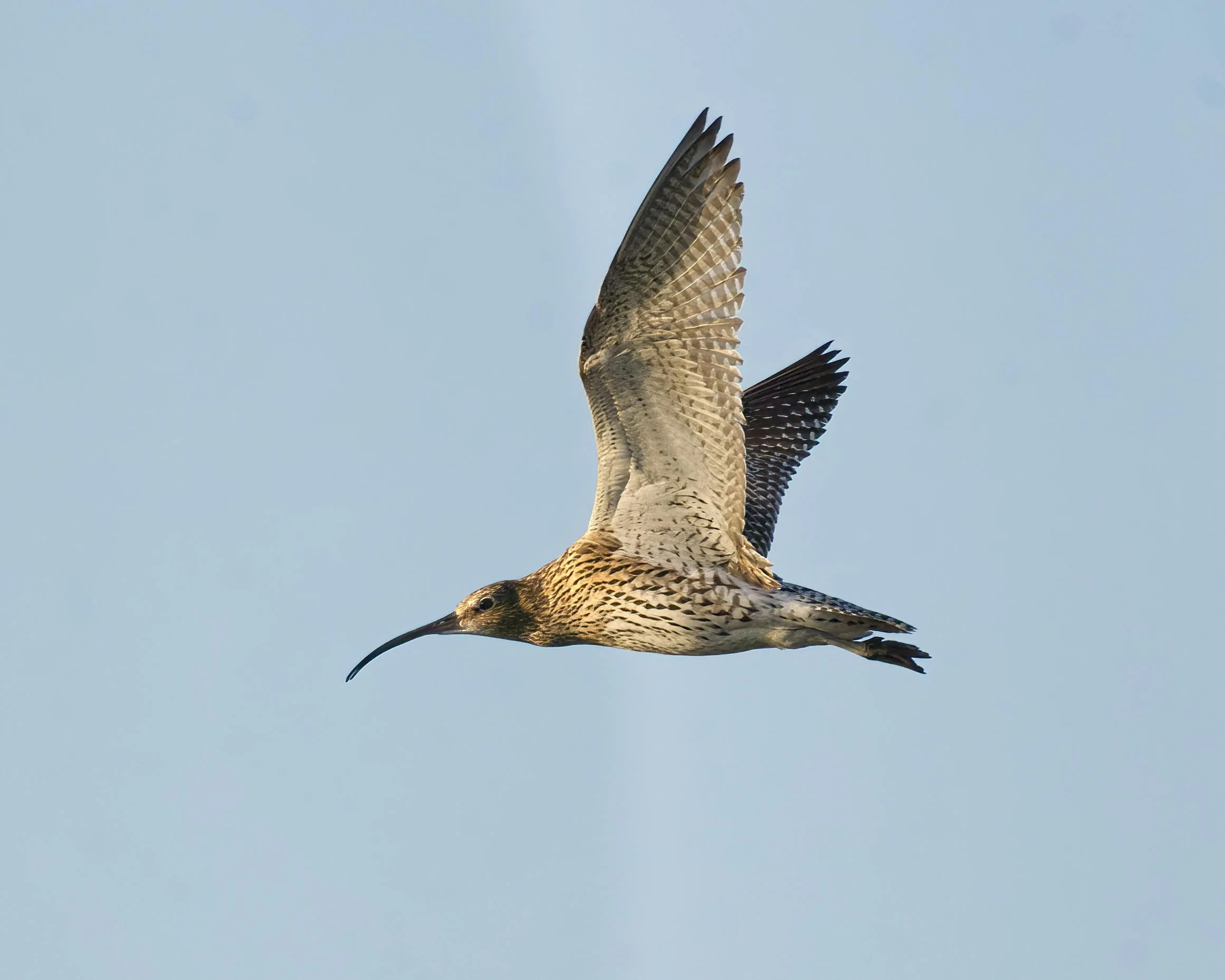
I want to get involved in efforts to protect the eurasian curlew. Because it means a great deal to me and many people who live in the countryside of Västerbotten.
Birds enrich our lives with their songs and calls. But for me, no sound is more moving than the call of the curlew. A few years ago, I played a recording of it during a presentation in southern Sweden, and no one in the room recognized it. That made me sad because the curlew used to live in that specific area. I grew up with that sound. Today, however, it has disappeared from many parts of the country, and the population is declining even here in the north.
That is why I want to share something I recently read by Patrick Laurie, a farmer and conservationist in Galloway, Scotland, who has witnessed the curlew’s decline over the past twenty years. He fears that 2026 may become the first year in which not a single curlew even attempts to breed in his part of Scotland.
He writes:
“Sometimes I hear lone curlews passing overhead beneath the stars. They’re calling absent-mindedly on the way to somewhere else, but these birds always have an ear cocked for a reply from the ground. As it stands, there are no replies from the ground anymore, so these transient birds just keep moving.”
Patrick describes how difficult it is to turn love for a species into real change. Many farmers genuinely want to do the right thing, yet still take the wrong actions – or not enough action. And even when one farmer does everything right, a neighbour who cares a little less can undermine the entire effort. Moreover, commitment is rarely sustained. It comes in waves.
A friend who read Patrick’s article reminded me of something important: much conservation work takes place too far downstream in the system. We react to symptoms instead of addressing root causes. Patrick also writes about those who neither hate or love the curlew – they just don’t value it. That may be the hardest challenge of all. How do we change social norms? How do we expand the circle of things people feel empathy for? Does it always come down to economics, or are there other paths?
The curlew needs something that I’m not sure we can even provide: uninterrupted commitment, long-term care, built on genuine knowledge – year after year, season after season. That kind of persistence is difficult to maintain, both for those of us who want to help and for the farmers themselves.
I can still hear the curlew here in Västerbotten. Right now, they are sitting on their eggs, almost impossible to detect. The bird that is not incubating stands watch over the territory and is often clearly visible.
But yesterday I saw both the male and the female together in a field in the village. That pair was no longer nesting. Most likely, their breeding attempt was interrupted by spring ploughing.
Could we have done something? Perhaps if the farmer had received help locating the nest. But we didn’t know, or we didn’t act in time. Galloway is a warning of precisely this: knowledge does not always reach people soon enough.
Do we dare commit ourselves to the long-term responsibility that is required? Are there enough of us, and are we persistent enough – those of us who want to help, and the farmers that can make it possible? How do we create a form of engagement that doesn’t come in waves but endures over time, alongside an agricultural sector that is changing, becoming more rationalized, and perhaps taking entirely new directions?
I don’t know. I want to explore these questions over the coming year.
But I do believe one thing: everyone who truly gets to know the curlew – its call, its way of life, its faithfulness to the places it returns to – will also want to fight for its survival.
That is something we can build on.
Opinion article by Anders Enetjärn, published in Västerbottens-Kuriren on 1st June 2026.